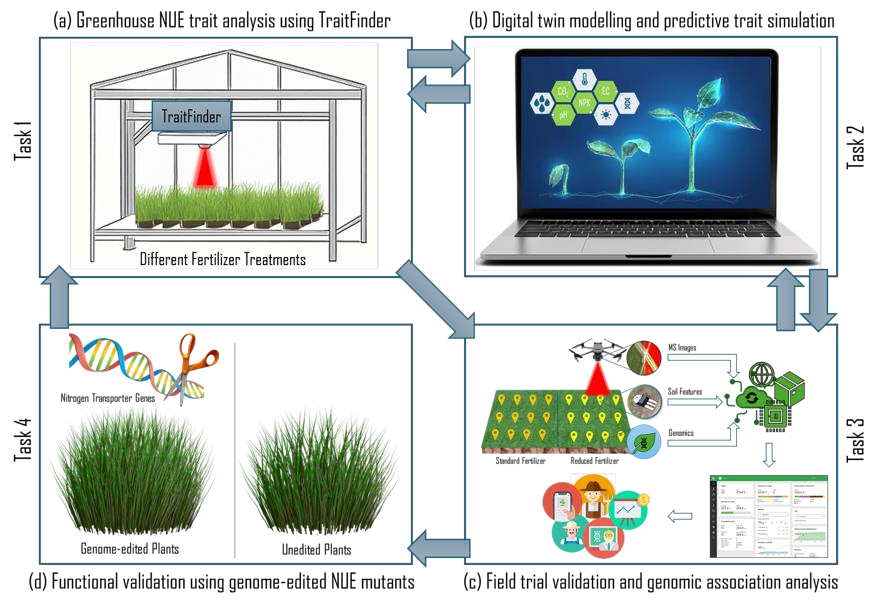
We apply deep learning, convolutional neural networks (CNNs), and other ML approaches to solve challenges in plant science. Applications include image-based phenotyping, genomic prediction, digital twin modeling for NUE scenarios, and real-time decision support tools for farmers and breeders. We also develop ML-driven apps for optimizing harvest timing and forage quality assessment.
Our AI research bridges the gap between raw sensor data and actionable agronomic decisions. Drone and robot imagery from field trials is processed through custom CNN architectures trained to segment individual plots, classify plant health status, and estimate biomass. These models are deployed as part of our data analytics platform, providing autonomous processing of multi-temporal, multi-sensor datasets.
A key innovation is our digital twin framework, which integrates genomic, phenomic, environmental, and soil data into a unified simulation environment. By running virtual nitrogen management scenarios, breeders and agronomists can evaluate how different genotypes perform under varying fertilizer regimes before committing resources to field trials. We are also developing ML applications to give farmers real-time crude protein and dry matter estimates and also supporting optimal harvest timing decisions.
Digital Twin: Nitrogen Response Simulator
Explore how reducing nitrogen fertilizer affects forage grass yield and quality. The left side shows full nitrogen (100%), while the right side shows the impact of your chosen reduction. Adjust the slider to simulate different scenarios.